
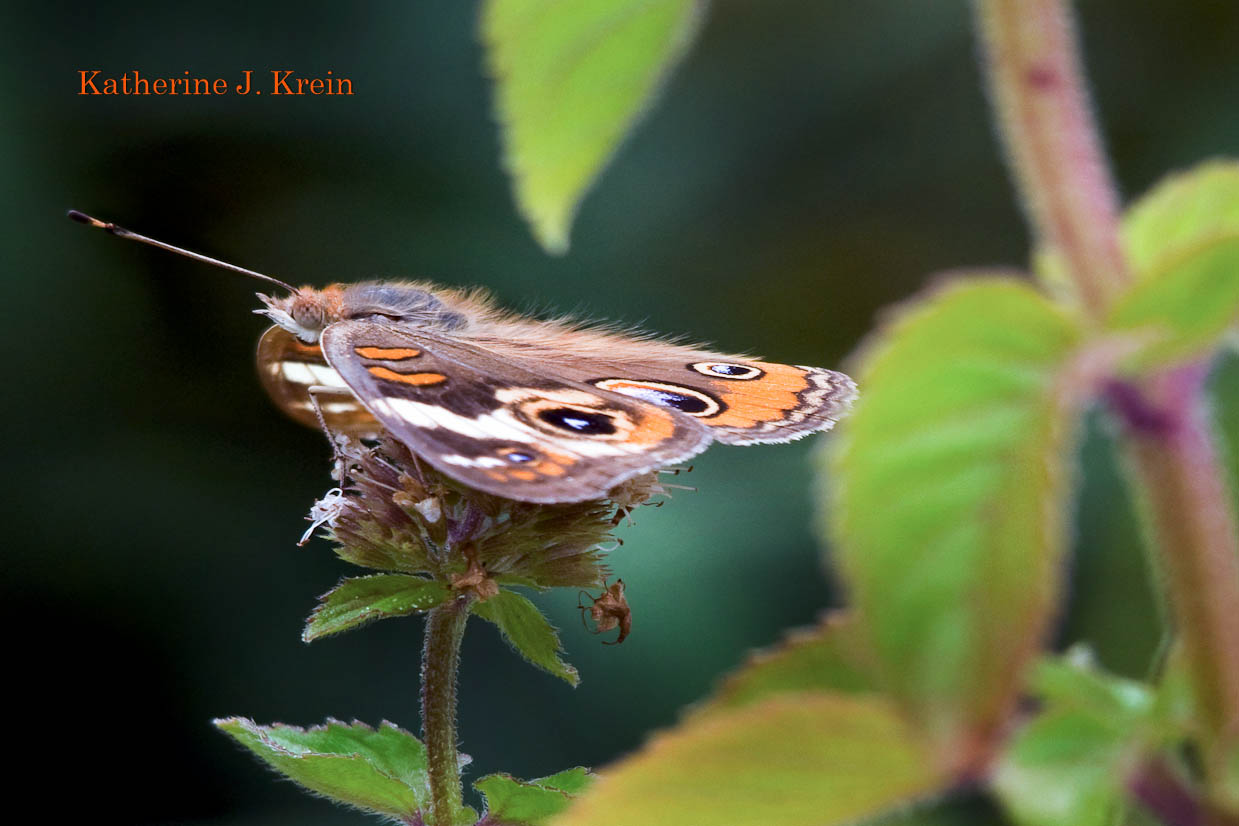
The common name for this butterfly comes from the brown poisonous seed of the buckeye tree that resembles a deer's eye.
Buckeye trees are found in large numbers in the state of Ohio, and this is why people from the state are sometimes called 'buckeyes'. I am not sure why this butterfly got this name other than its eye-spots resemblance to the buckeye seed. This butterfly has a large geographic range and is not exclusive to Ohio nor is the tree its host plant.

I would argue that because this butterfly's scientific name Junonia coenia comes from the mythological goddess, Juno, the common name should be related. The peacock bird was the sacred bird of Juno, and the story is told that peacock feathers  immortalize Juno's faithful servant, Argos Panoptis, an enormous giant with 100 eyes. The common name of peacock butterfly would honor its scientific name more suitably. Also the butterfly's eye spots more closely resemble the eye-spots of a peacock feather than the eye of a deer. However, it is what it is and there is no real need to change it at this point.

If you are like me, you can see faces in the wings of this butterfly.
This phenomena is called pareidolia, which is the tendency to assign meaning to patterns.
The most common type of pareidolia is seeing faces in inanimate objects.

There is a psychology test called the Rorschach test. This test supposedly indicates a person's personality or mental state based on their interpretation of a series of ink blots. I always think of this test when I see images in patterns.

I wonder how what I see would be interpreted by a psychologist. It would not really make any difference in how I think about myself, however, I would be curious.

 movingforwardslowly