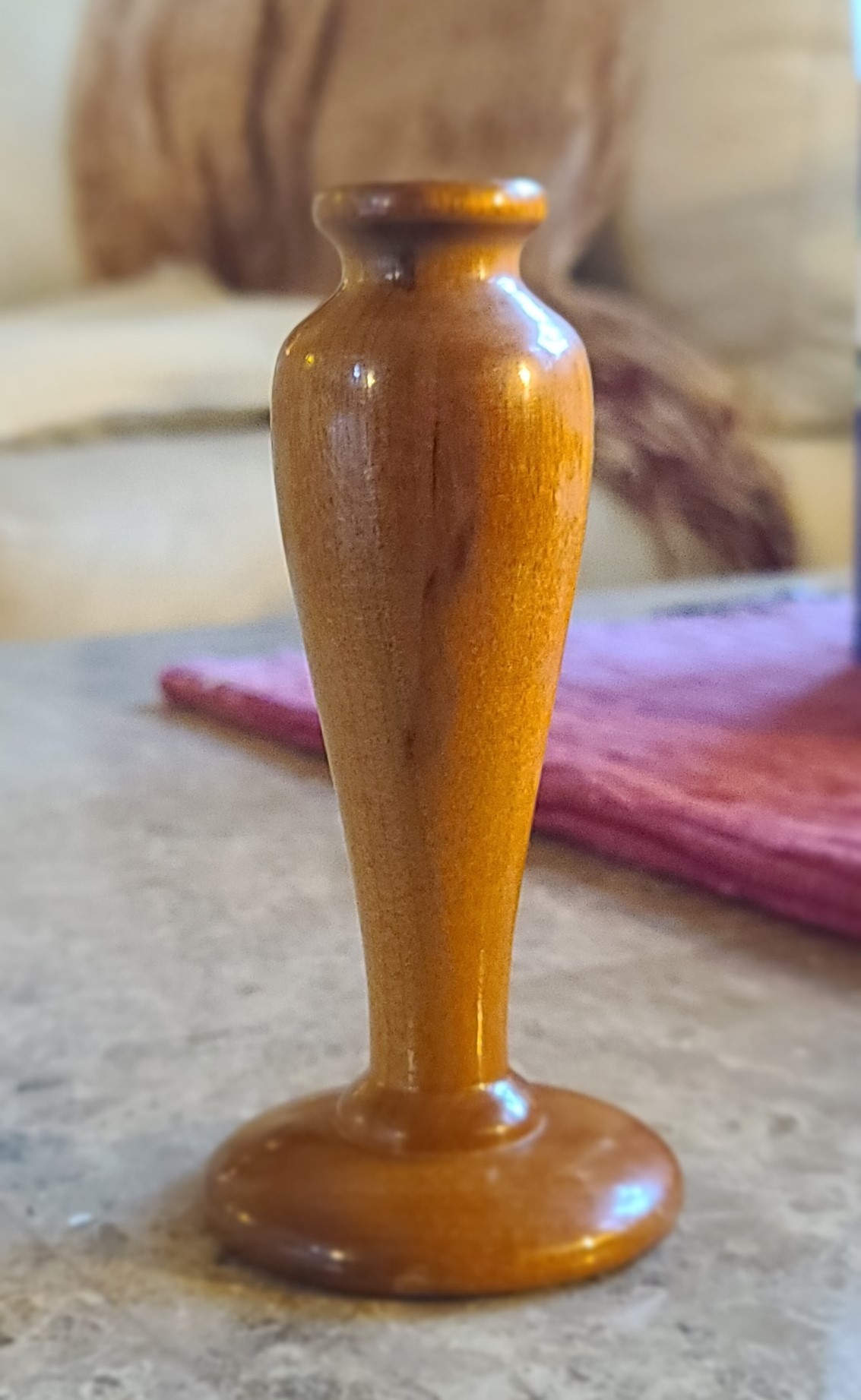
Myrtle was the name of my grandmother, my mother’s mother. She had been given a Myrtlewood vase. It is pictured above, and it is labeled beneath its base. I inherited it from her.
While researching Myrtlewood I discovered that in Hebrew the name Hadassah means “Myrtle tree.” I was surprised to learn this because my father’s paternal grandmother was named Hadassah, though mostly she was called Hattie. So, it turns out there was a Myrtle on both sides of my family tree.
There are many different species of Myrtle trees.
The vase is most likely made from Oregon Myrtlewood. The Latin name of this particular tree is Umbellularia californica, and its common names are Bay Laurel, Pepperwood, or Oregon Myrtlewood.
This Myrtlewood tree can grow very tall in the wild. It is a slow grower and it may take 120 years to reach full size. They have a deep tap root system so they can regrow as shoots from stumps or nurse logs. This strong root system helps to regenerate the species in the wild.
Myrtlewood can be found in a wide variety of colors and grain patterns, and it is considered one of the world’s most beautiful woods.
The Oregon Myrtle (or California Laurel) is neither a Laurel tree nor a Myrtle tree. The broadleaf evergreen grows only on a narrow strip of inland land along the Pacific coast between northern California and southern Oregon.
The aroma is very distinctive, and some local cooks use the leaves, which are similar to bay leaves. It is said that the Myrtlewood leaves taste spicier and you will not forget their aroma
 Read about Myrtlewood money here. https://www.opb.org/artsandlife/series/history/myrtlewood-money-north-bend-oregon-great-depression/

 movingforwardslowly